Because we’re low-till in Georgia, the clay soil has to be broken up somehow. This requires measures some might call extreme. It requires a tool many may no longer recognize — a tool that to me resembled a medieval torture device when I first saw it. It is known as the broadfork.
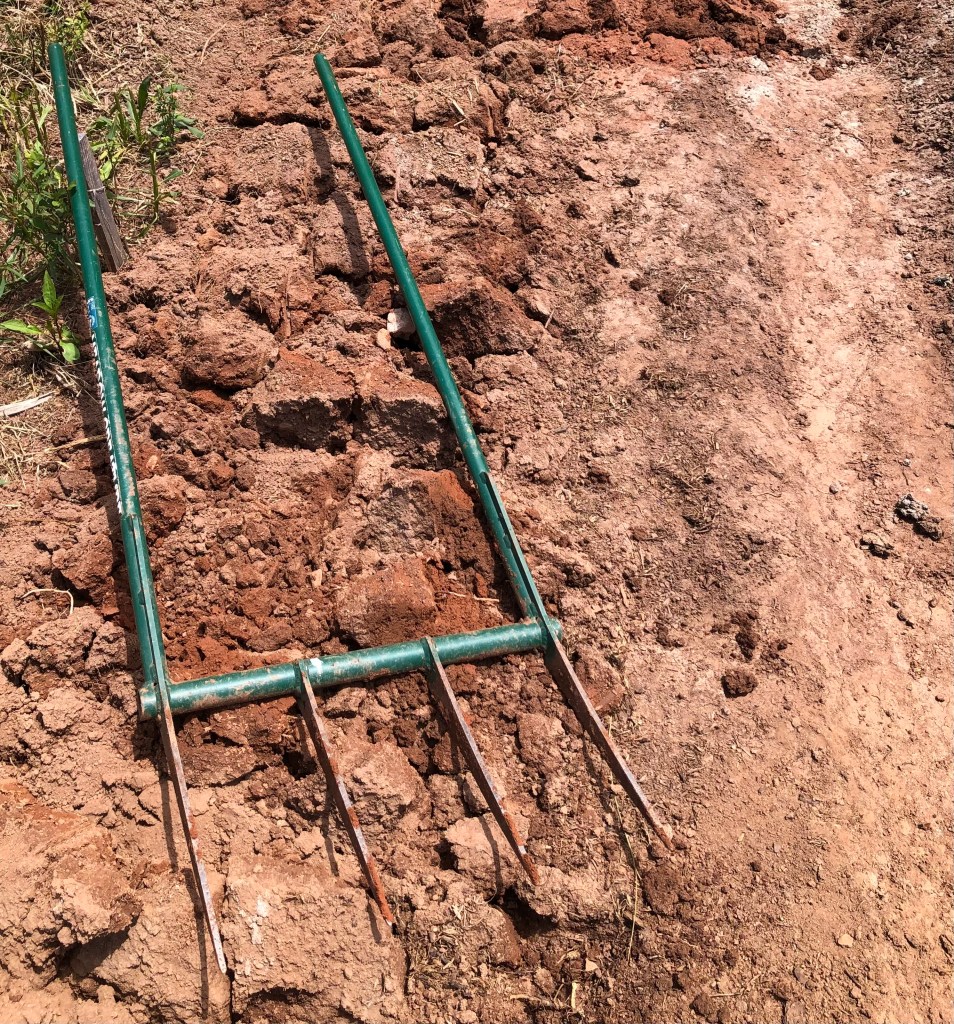
This particular version is from a company called Meadow Creature*, and I think of my broadfork as The Meadow Creature. It’s all steel and will break up the reddest of clay. It can be a workout, and working hard soil after a good rain makes the job a bit easier. Because of how the land lays and because we did one initial till to form the plots we use now, the soil isn’t too tough to work with, but it does need some “fluffing” each season, depending on how hard the previous season was on a given row.
Why this tool is better than a tiller is a question of soil structure. Both will loosen dirt to ease the planting process and promote root growth, but they affect the soil in different ways. Soil exists in layers, and it’s alive — not just with bugs, but with tons of microorganisms that increase its fertility and work with root systems to provide plants everything they need to thrive. It takes years for this network to grow and create that beautiful, black crumbly soil everyone loves.
A tiller inverts these layers and destroys the complex web of life that is so vital to healthy plants. How many layers are affected depends on the kind of tiller used, but the effect is the same. They can seem effective because the soil is certainly loosened for planting, and they’re certainly efficient. However, it’s at the expense of soil health. Then farmers are forced to compensate with amendments, fertilizers, and even pesticides. Repeat tilling of the same ground can also leave a hardpan that plant roots can’t penetrate.
A broadfork, on the other hand, only affects the soil vertically. Those nasty looking tines are jabbed straight into the ground, and then pushed deeper with body weight. That cross bar the tines are welded to are meant to be stepped on, and yeah, it’s pretty fun to hop up there! Tough soil requires some side-to-side rocking to help the tines sink all the way in. Then, with feet back on the ground, body weight is again used — this time backward on the handles — to pull the tines up, lifting the soil with it. This loosens the soil, allowing air and water to move around more freely, but because the action is all vertical, the soil layers remain intact.
We aren’t anti-tiller, but we choose to use them selectively. It’s a great way to break new ground. There are other ways to create a new gardening plot without tilling, but they typically require a ready source of materials, as well as a great deal of patience and upkeep, and years’ worth of advance planning. The common theme is covering the desired plot with compostable material and allowing it to break down over time. The material could be mulch, leaves, or cardboard. There is also a fun approach called hügelkultur, which uses decaying wood for long-term plant nutrition.
For a personal garden, I say play away. But at Veggie Charm Gardens, we’re budgeting both time and money, a more efficient start is needed. So we do till once to break ground, but after that, we let nature work the way it wants to, helping out a bit with organic material and any necessary amendments, such as dolomitic lime. Another use for a tiller that doesn’t hurt the soil structure has been demonstrated by Jean-Martin Fortier*, who wrote The Market Gardener and has created several other gardening resources. He establishes a system of permanent beds, then uses a walk-behind rotary plough on the paths between them. This digs up dirt from the path and dumps it onto the bed next to it. The soil structure in the planting area is not disturbed at all, and loose organic matter is added right where it’s needed. It’s a technique we hope to use one day, as it will allow us to use our time much more efficiently.
In the meantime, that Medieval beast in the picture above is one of the most handy and amusing tools in the VCG shed. We’ve got several rows of veggies planted with more on the way, so stay tuned here and at our Facebook page for updates on what’s ready for harvest. We love sharing what we grow!
*Note: These are not affiliate links; I sincerely recommend both companies. If we ever do form an affiliate relationship with either one, it will be noted right here.
 Veggie Charm Gardens