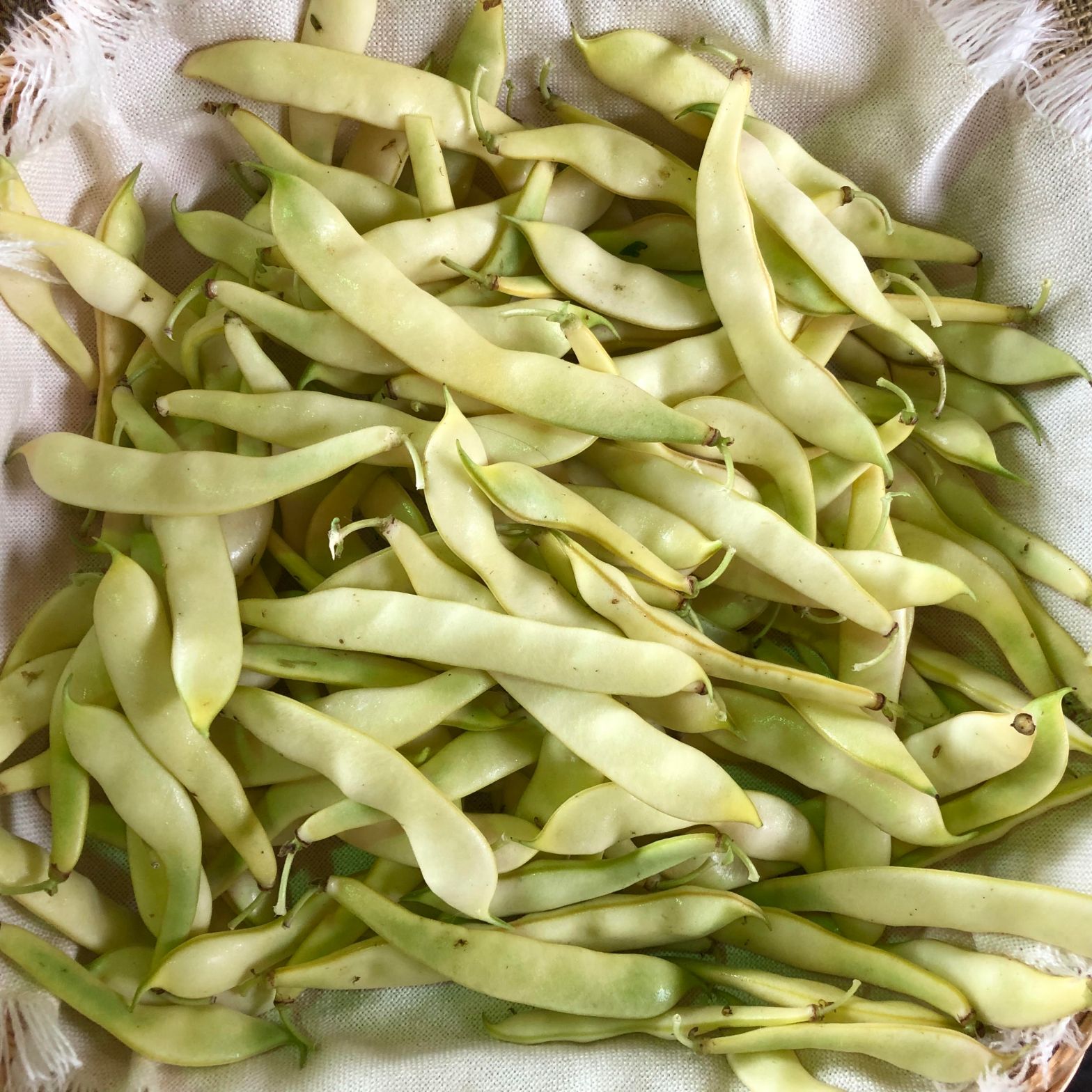
More questions are asked about our yellow Romano beans than all our other produce combined. Most people have never seen such a bean before. The most common is by far, “What is that?”
I learned from a local real estate agent that the “What’s that?” factor is bad. Really bad. That’s perfectly valid when buying and selling real estate. But I’m selling beans, not houses, so I don’t mind when people ask, “What is that?” I like to grow interesting and pretty food, and Romano beans happen to be my favorite “green” bean to eat.
Very simply, this yellow variety is a cousin to the Italian green bean. They are flat beans that are cooked and eaten just like regular green beans. Our seed company describes them this way: “A taste sensation, these glowing yellow Romano beans have a delicious, full flavor and a smooth, tender, stringless texture. The upright, bushy plants are lavishly covered with 4 ½–5 inch long pods that are ½ inch across. The plants proudly yield heavy crops of robustly flavored beans that exhibit their golden color even when pods are small.”
I will say that ours tend to take on their yellow hue a bit later in their maturity and have more developed beans within the pods. Likely this is due to the Georgia climate; our seed company grows and tests their seeds in the Pacific Northwest. But their seed always has an amazing germination rate and produces beautiful fruit, so we dub them honorary Southerners and deal with any plant quirks that crop up.
The second most often-asked question about these beans is, “How do you cook them??” I usually say, “Just like a regular green bean.” But here I’ll share my personal recipe, which is quite simple, because the less fuss in the kitchen, the better.
Grab a mess of beans (adjust if you’re cooking for 1-2).
Wash/rinse well and drain.
Snap or snip off each end (I leave as much bean as possible).
Toss them in a pot (stock pot for a big mess or sauce pan for feeding 1-2).
Add cold water until it just covers the beans.
Cover the pot and set to boil; once boiling, turn the heat down to a high simmer.
Let them simmer for around 10 minutes for a more cooked dished; for firmer beans, simmer for less time.
I add my salt after draining. Some people like to add it while the beans boil.
For a real mess of beans, add around a tablespoon of salt, but maybe a teaspoon for 1-2 people.
If you haven’t drained the water off yet, do that before adding the other seasonings.
I add about a teaspoon of pepper for a big pot and about a 1/4 teaspoon for a small pot.
Then I add a sprinkling of garlic powder.
Use a spoon to turn the beans over and get them evenly coated with flavor (or do like I do: pop the lid on and shake the daylights out of them).
Serve hot with your favorite entrée.
Ok, that was a lot of steps to say, “boil to desired tenderness and season to taste,” but you get the idea! If you like to do beans fancier, go for it! I think they’re up for it. If, however, you just have to have that cylindrical pod, you’ll have to visit one of our fellow vendors. And that’s ok! We love each other, and everyone at Coweta County Farmer’s Market grows good food.
Either way, we hope to see everyone out there.
Our 2024 season is almost halfway over already, so stop by soon!
 Veggie Charm Gardens